Cued Articulation Chart Free Printable – Cued Articulation is a visual system of hand cues developed by Australian speech pathologist Jane Passy. It helps children (and adults) see how speech sounds are made. Each of the roughly 49 English phonemes has its own simple hand gesture that shows three key features: where the sound is produced in the mouth (placement), how the air flows (manner), and whether the sound is voiced or voiceless.
The system pairs these cues with color-coding for written letters. It supports speech production, phonological awareness, early literacy, and pronunciation work for English language learners. Speech-language pathologists, teachers, and parents in the United States and elsewhere use it as a multisensory tool alongside traditional articulation therapy or phonics instruction. Note that Cued Articulation is distinct from Cued Speech, a different system that supports language access for deaf and hard-of-hearing individuals.
Why People Search for a Cued Articulation Chart Free Printable?
A clear, printable reference chart or set of posters makes the hand cues easier to learn, remember, and use in therapy rooms, classrooms, or at home. Many educators and SLPs want a ready-to-print visual for daily practice or wall display. While the complete official system appears in Jane Passy’s published materials, several legitimate free or low-barrier resources help people get started with supporting visuals.
Free Printable Resources You Can Use Today
One of the most directly relevant free options is a Cued Articulation Alphabet Display and Alphabet Chart created for classroom use. It includes display posters for each letter of the alphabet plus a full alphabet chart designed to support Jane Passy’s system. You can download the free PDF here:
Cued Articulation Alphabet Display and Alphabet Chart (Teachers Pay Teachers).
For a complementary free resource that many U.S. SLPs already use, download an informal articulation screener paired with an IPA chart and vowel quadrilateral. These charts clearly show place, manner, and voicing—exactly the features Cued Articulation highlights—and work well as reference materials during sessions:
Free Articulation Screener and IPA Chart (Allison Fors).
A clear, parent- and teacher-friendly explanation of how the hand signs work (placement, manner, and voicing) is available from a trusted UK National Health Service speech and language therapy service. It is an excellent starting point before introducing any visual aids:
Cued Articulation Overview (Sheffield Children’s NHS Foundation Trust).
Additional practical background on classroom and literacy applications appears on the British Council’s TeachingEnglish site:
Cued Articulation (British Council TeachingEnglish).
Training and further implementation ideas are offered through Sounds for Literacy (courses approved in connection with Jane Passy’s work):
Sounds for Literacy – Cued Articulation Resources.
These five sources keep you within legitimate, currently available materials. Always verify that any download matches your needs and that you have permission for the intended use (personal, classroom, or clinical).
Cued Articulation Chart Free Printable
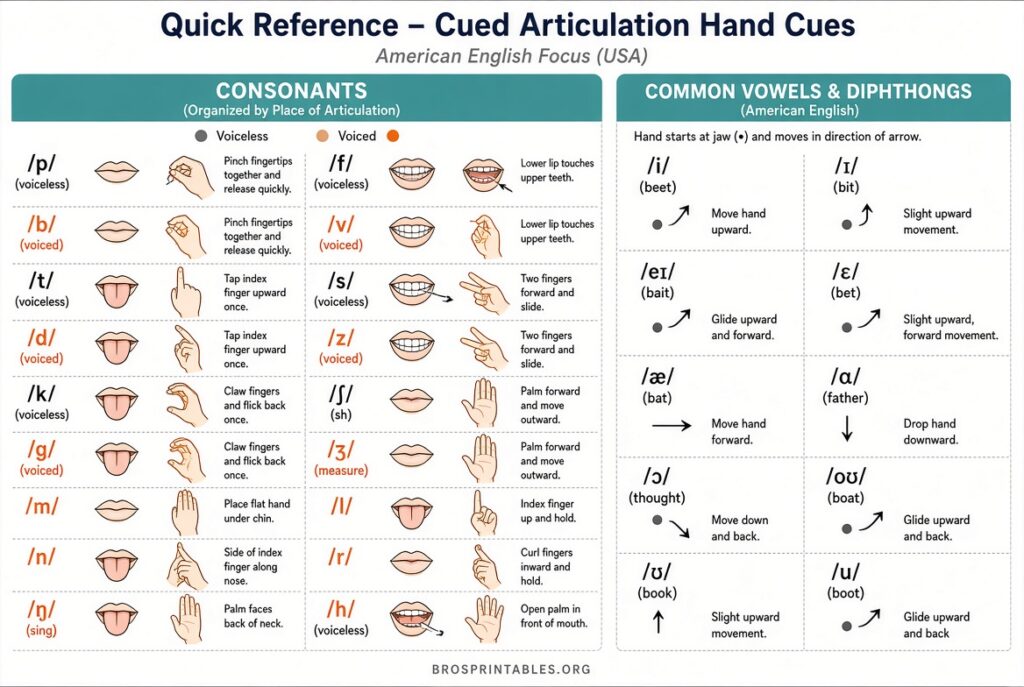
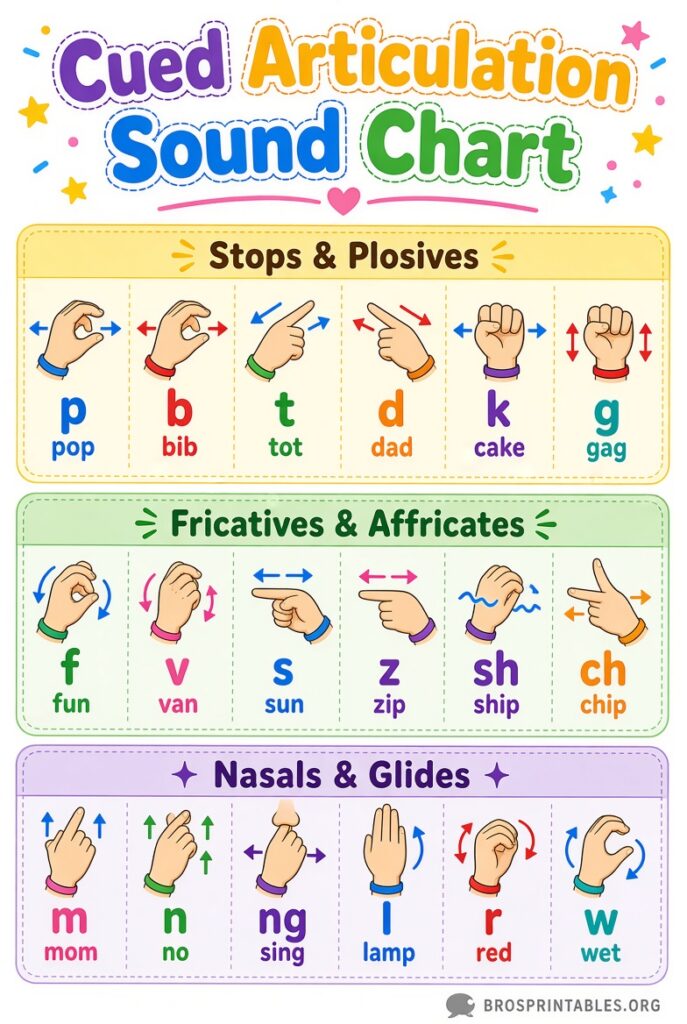
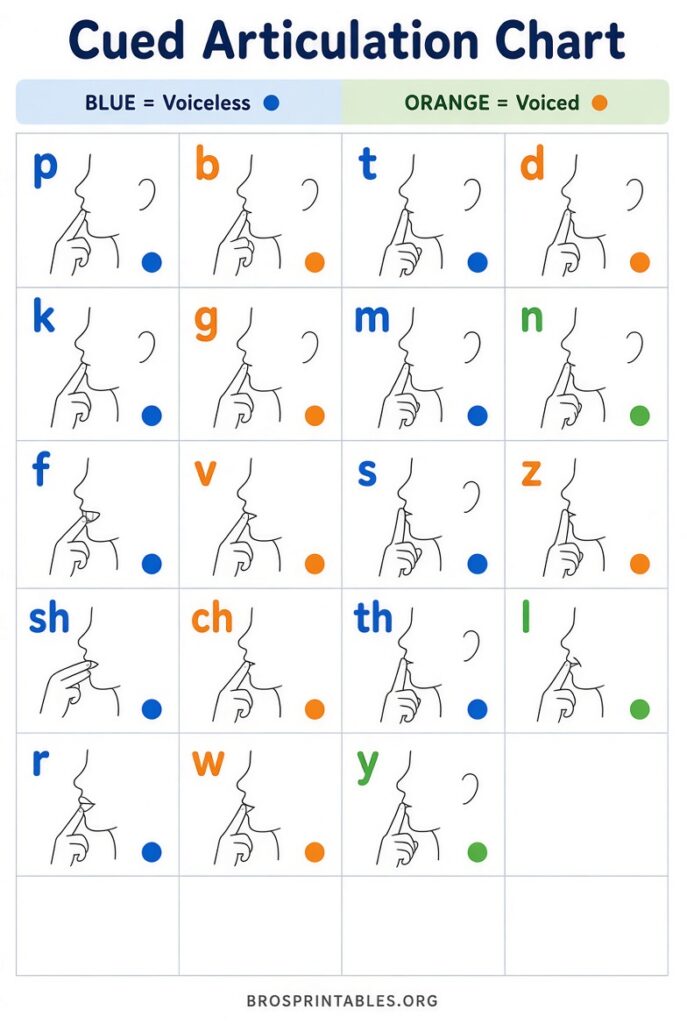
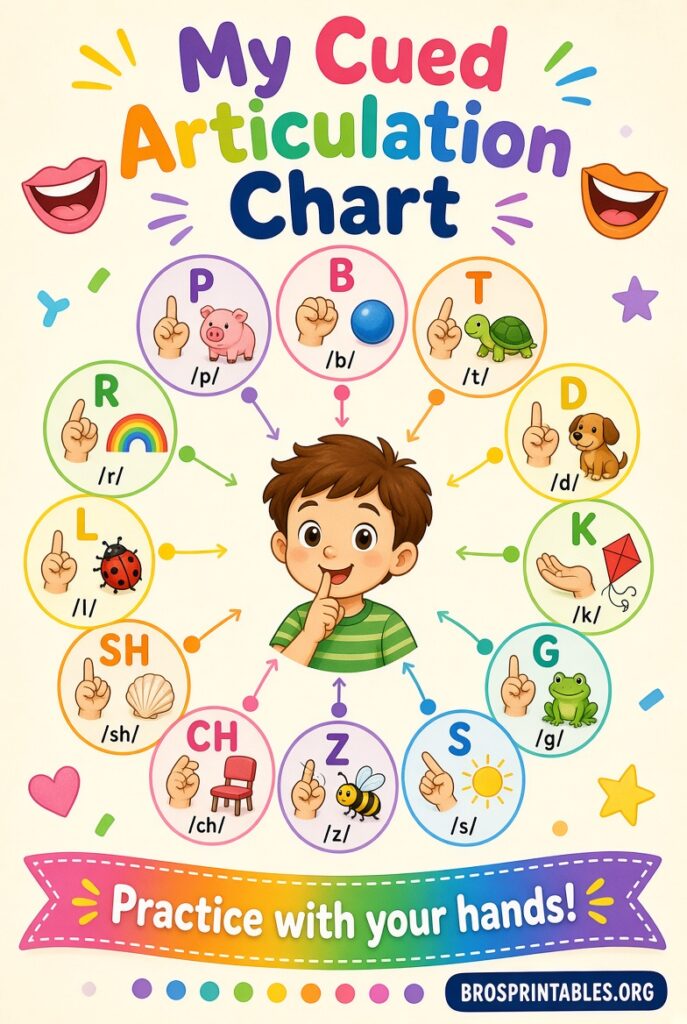
How to Use a Cued Articulation Chart Effectively?
Print the alphabet display or IPA-style reference on sturdy paper or cardstock. Laminate if you plan heavy use. Introduce only a few sounds at a time, modeling the hand cue while saying the sound. Pair the visual with real mouth demonstrations and immediate practice in words. Color-coding (when available) reinforces the link between the spoken sound and its written form. Consistency across home and school helps children generalize the cues.
Many U.S. clinicians combine Cued Articulation principles with evidence-based articulation therapy approaches and phonological awareness activities. Consult a licensed speech-language pathologist for individualized guidance, especially when working with speech sound disorders.
Quick Tips for Parents and Educators
- Start with high-frequency early-developing sounds.
- Keep sessions short and positive.
- Use the chart as a quick visual reminder rather than a full curriculum replacement.
- Check that any free printable respects copyright; the resources linked above are offered as free downloads by their creators.
Brief FAQ
Is there an official free full Cued Articulation chart from Jane Passy?
The complete system with detailed illustrations is published in the book Cued Articulation: Consonants and Vowels (revised edition). Free supporting materials such as the alphabet display and general IPA/articulation charts listed above are the most accessible starting points.
Can I use these printables in a U.S. school or clinic?
Yes, provided the specific free resource’s terms allow it. The Teachers Pay Teachers alphabet set and Allison Fors materials are commonly used by American educators and SLPs.
How is Cued Articulation different from other visual phonics systems?
It is specifically designed around linguistic features of English speech sounds (place, manner, and voicing) and uses logical, easy-to-produce hand movements rather than arbitrary gestures.
A well-chosen free printable chart, used consistently with clear modeling, can make speech sounds more visible and memorable for many learners. Start with the free alphabet display and IPA reference linked above, pair them with accurate modeling, and seek professional support when needed for the best results.