Free Printable Communication Cards – Free printable communication cards are simple visual tools that help people express needs, feelings, choices, and basic messages when spoken language is limited or unavailable. These cards—often called picture cards, PECS-style cards, or low-tech AAC (Augmentative and Alternative Communication) supports—feature clear images paired with words. Users point to or hand over a card to communicate.
They are especially useful for autistic individuals, people with speech delays or apraxia, those recovering from stroke or brain injury, hospital patients, and anyone facing temporary communication barriers. In the United States, families, speech-language pathologists, teachers, and caregivers commonly use them at home, school, therapy sessions, and medical settings. Free printable versions make high-quality visual supports accessible without cost.
What Are Communication Cards and Why Use Them?
Communication cards form part of low-tech AAC systems. Unlike speech-generating devices or apps, these paper-based tools require no batteries or screens. A typical set includes core vocabulary (high-frequency words like “want,” “more,” “help,” “stop,” “yes,” and “no”) plus fringe vocabulary for specific needs such as food, feelings, bathroom, or medical symptoms.
Benefits include reduced frustration, greater independence, clearer interactions, and support for language development. Research and clinical practice from organizations like the American Speech-Language-Hearing Association recognize AAC—including picture-based systems—as evidence-based support for many communication needs. Cards work well alongside speech therapy or as a backup when high-tech devices are unavailable.
How to Use Free Printable Communication Cards?
Start small. Choose a few high-priority cards that match daily routines (for example, “eat,” “drink,” “toilet,” “help”). Model their use by pointing to the card while speaking the word. Encourage the person to hand or point to a card, then immediately honor the request so they learn the connection.
Practical setup tips for U.S. households and classrooms:
- Print on cardstock or heavy paper for durability.
- Cut cards to a consistent size (common sizes are 1.5–3 inches square or 3×5 inches).
- Laminate them so they withstand repeated handling and cleaning.
- Add Velcro dots on the back for easy attachment to a binder, board, or choice strip.
- Keep a small set in a portable pouch or keyring for outings.
- Create a simple communication book or board by arranging cards by category.
Many free resources include ready-made sentence strips (“I want…”) so users can build short phrases by arranging cards in order.
Where to Find Legitimate Free Printable Communication Cards?
Trusted sources offer ready-to-print PDFs or customizable templates. Always download from official pages and respect any usage terms (most free educational resources allow personal, classroom, and clinical use).
Here are reliable options:
Kenhub provides free downloadable PDF communication cards designed for AAC use in healthcare and everyday settings. These include color and high-contrast monochrome versions covering needs, emotions, medical symptoms, and personal information. They are suitable for adults and children. Access them here: Kenhub Free AAC Communication Cards.
Spectrum Unlocked offers free PECS-style card templates and printables specifically helpful for autistic children and families. Sets cover core requests, feelings, food and drink, classroom needs, routines, and more. You can download ready-to-print PDFs or customize symbols and photos in their free editor with no email required: Spectrum Unlocked Free PECS Printables.
Fluent AAC provides free printable communication boards in several formats (traditional multi-page, flip boards, and one-page options with core and fringe vocabulary). These work well as standalone low-tech AAC tools or device backups: Fluent AAC Free Communication Boards.
ARASAAC (Aragonese Centre for Augmentative and Alternative Communication) maintains one of the largest free pictogram libraries under a Creative Commons license. Search and download individual symbols or ready materials to create your own customized cards: ARASAAC Free Pictograms.
Lingraphica offers free printable communication boards focused on basic wants/needs and hospital or health-related phrases (available in English and Spanish for many sets). These are particularly useful in medical environments: Lingraphica Free Communication Boards.
These five sources prioritize clear visuals, accessibility, and practical vocabulary while remaining free for personal and educational use.
Free Printable Communication Cards
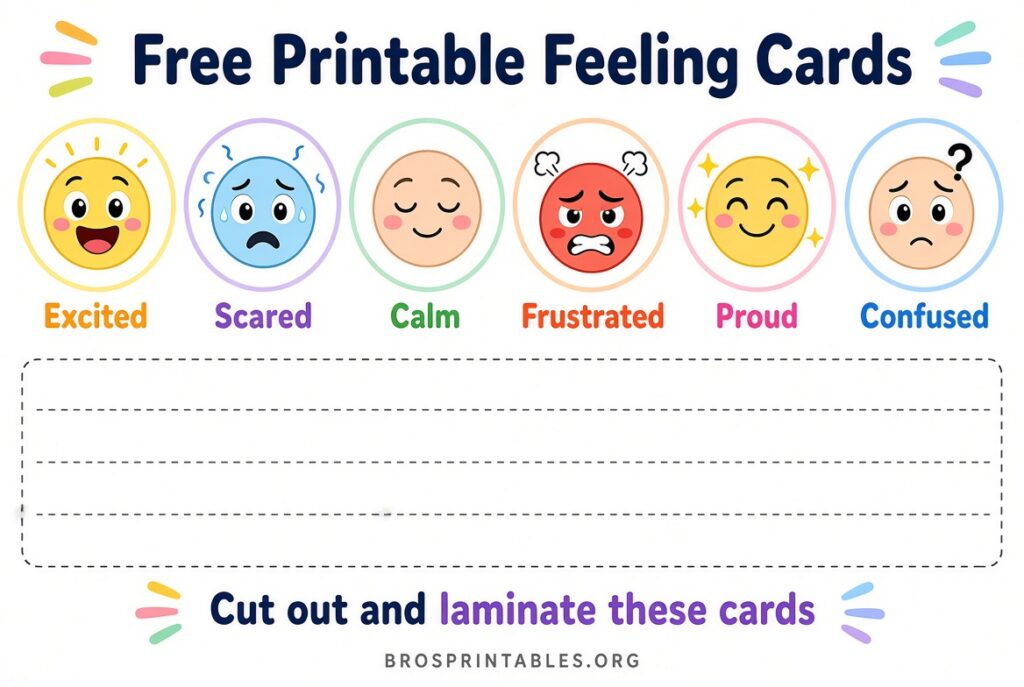
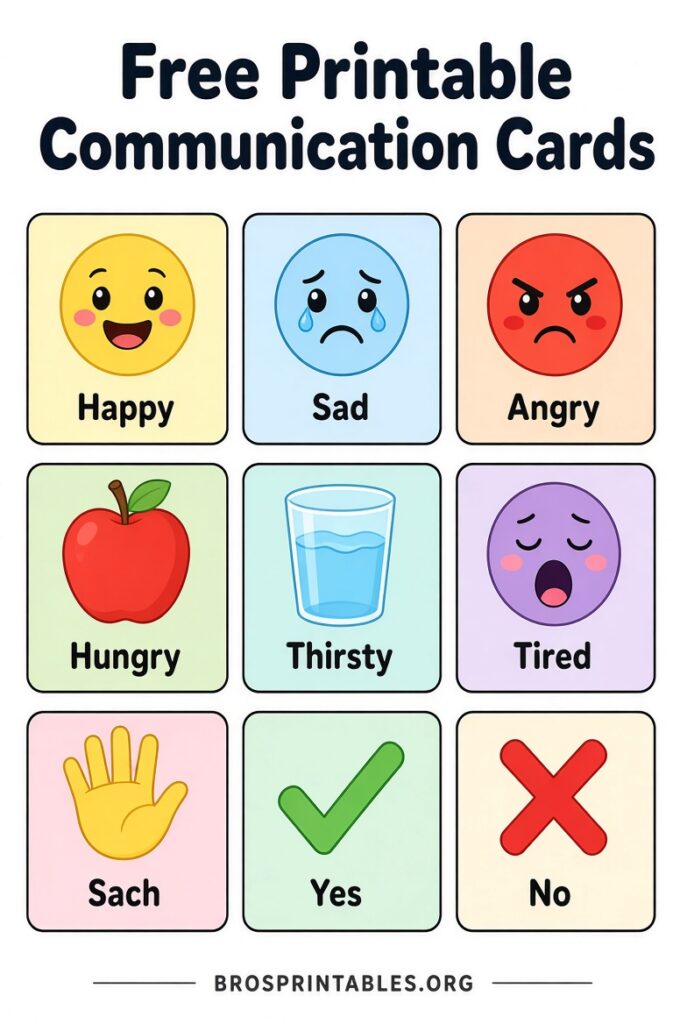
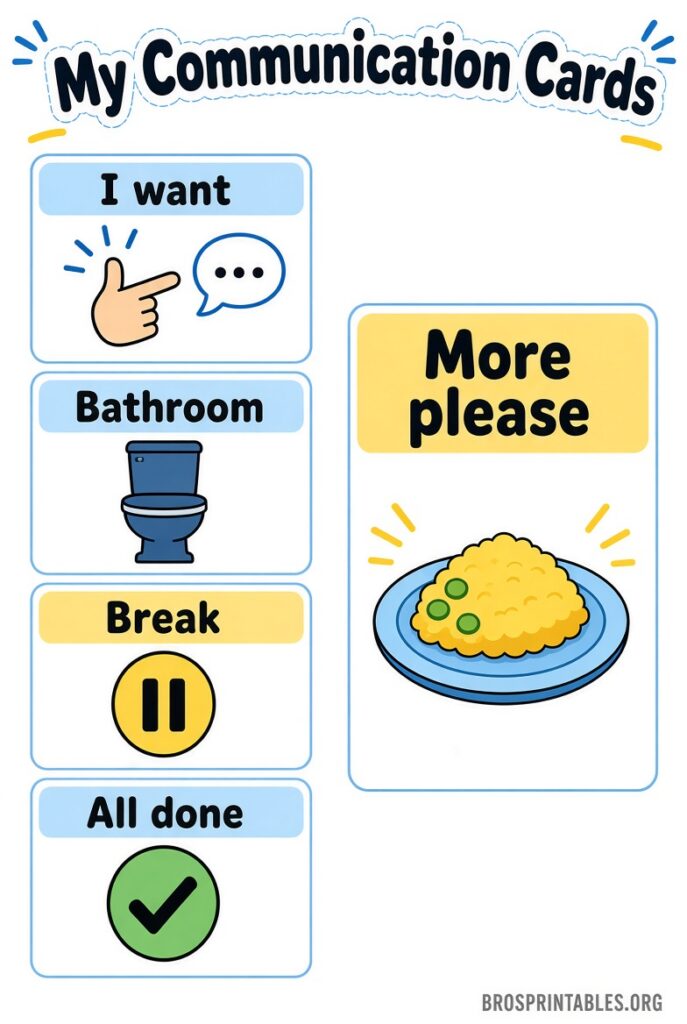
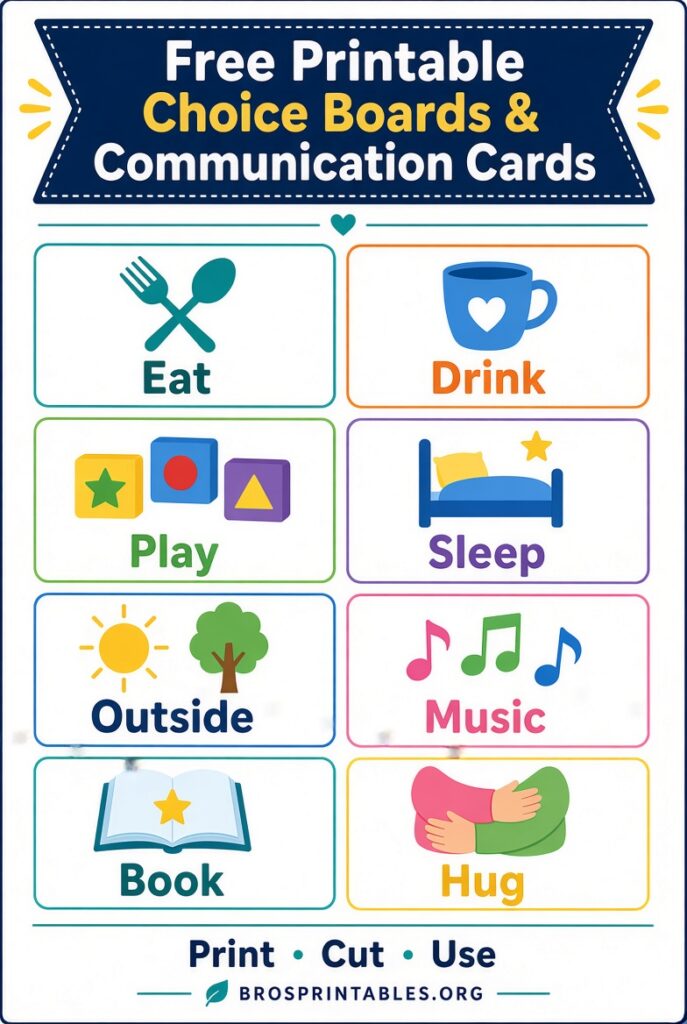
Tips for Making and Customizing Your Own Cards
If a ready-made set does not perfectly match needs, create personalized cards:
- Use free online makers (several of the sites above include editors).
- Photograph real preferred items (favorite snacks, toys, or people) for stronger motivation.
- Keep text large and simple; pair every image with a clear label.
- Organize by color-coding categories if helpful (a common AAC convention).
- Involve the user in choosing symbols when possible—ownership increases engagement.
Print a few extras. Cards get lost or damaged, and having backups keeps communication available.
Brief FAQ
Are free printable communication cards the same as official PECS?
No. PECS refers to a structured six-phase teaching protocol developed by Pyramid Educational Consultants. Many free picture cards are PECS-inspired or PECS-style and support picture exchange, but full PECS implementation usually involves training with a qualified professional.
Do I need special software or an account?
Most of the resources listed above offer direct PDF downloads or browser-based editors with no account required.
Can these cards replace speech therapy or an AAC device?
They are valuable supports and backups, not complete replacements. Consult a speech-language pathologist for individualized recommendations, especially for long-term or complex needs.
What paper and finishing work best?
Cardstock or photo paper plus lamination produces the most durable results. Standard printer paper works for temporary use.
Free printable communication cards lower barriers to meaningful interaction. Start with a small core set from one of the trusted sources above, model their use consistently, and expand as communication skills grow. These simple tools can make everyday conversations clearer and more successful for many people across the United States.